Discover how Recykal is revolutionizing waste management in India by transforming a massive, informal recycling sector into a transparent, data-driven circular economy.
 Rashmeet Kaur Chawla
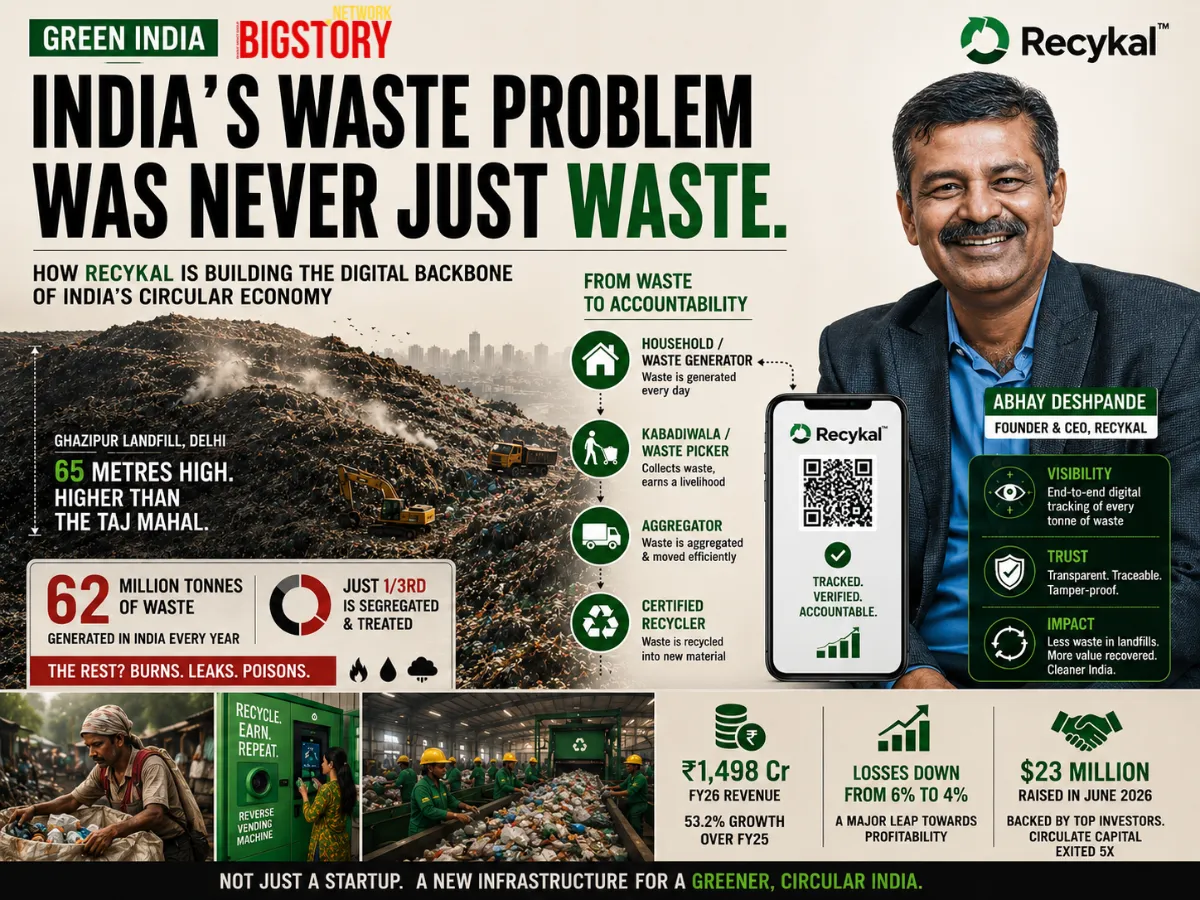
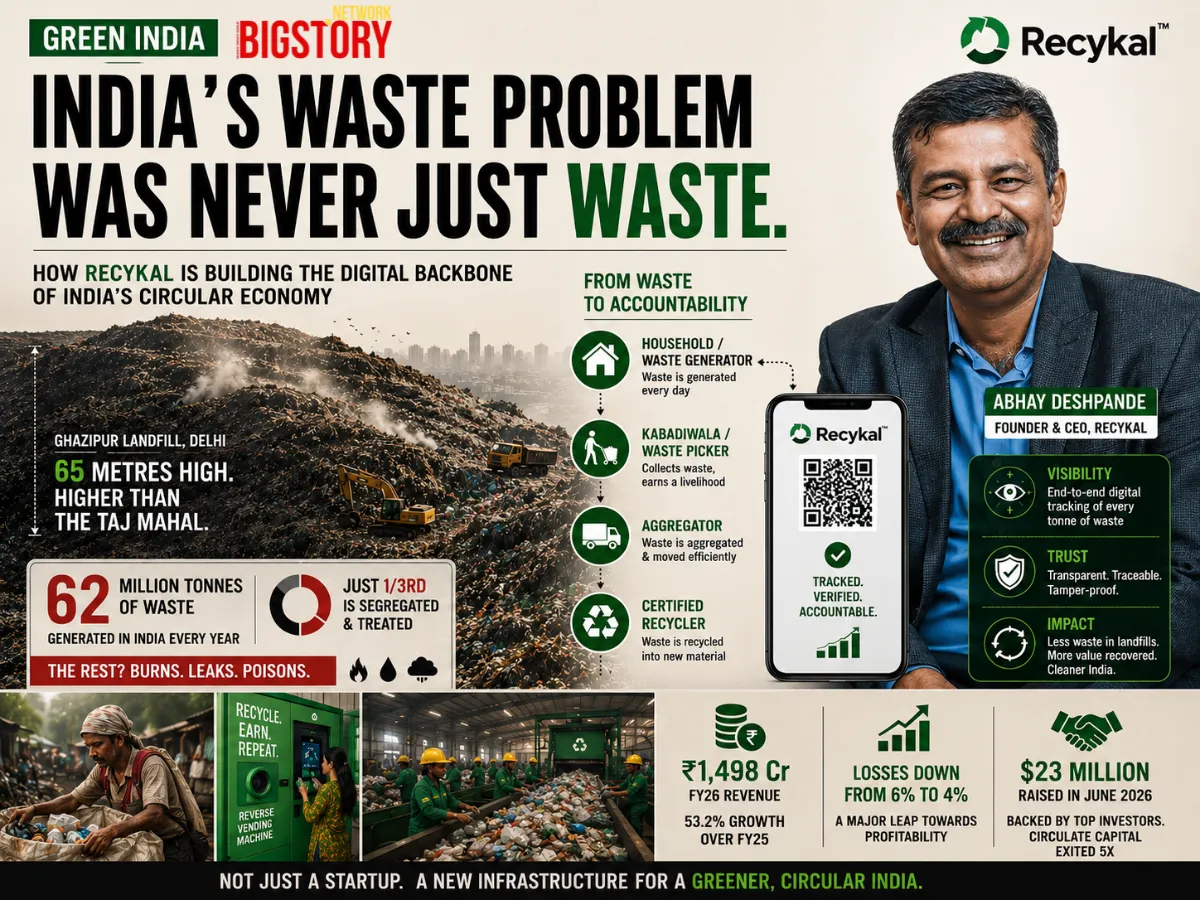
There is a hill in Delhi which does not appear in any geological map of the region, yet it towers 65 metres high- higher than how tall the Taj Mahal ever can be, completely made up of the waste products of the city. Ghazipur. In Mumbai, it has its replica in Deonar. No longer are they just landfills; they have become monuments for the broken connection between a nation and its garbage. And among those gloomy heaps of burning waste, some individuals in Hyderabad decided that the issue was not that India did not have recycling facilities.
It stays there, burning in landfills, leaking out into groundwater, poisoning the air Delhi and Mumbai children breathe on their way to school every morning. India's waste management problem had been painted in the past as a problem of non-existence of infrastructure for years lack of recycling units, lack of machines, lack of money for investment in technology.
The Recykal founders faced the same problem and recognized a completely different thing- they recognized that the chain lacked visibility.
The waste was moved in the cities on daily basis by a huge number of mostly invisible people called kabadiwalas - waste-pickers, who maintained the informal economy without any technology whatsoever, but with no digital presence, pricing standardization, and tracking of a tonne of plastic.
However, Recykal's moment of truth arrived in a peculiar manner, through policy. Extended Producer Responsibility in India made it mandatory for companies such as Coca-Cola and Unilever to recycle a similar volume of packaging that they sold into the market. On the face of it, it was a clear concept: whoever was selling plastic had to take care of the same after its usage. However, in reality, it ran smack into an entirely disjointed and unregulated collection chain.
How do you prove your compliance when the only way you are collecting waste is by paying a waste-picker, who then sells scrap to an aggregator in his/her vicinity, who then resells to an even bigger aggregator until he finally, possibly, reaches a certified recycling plant?
There was no record since there was almost none in the first place. Here were some major brands given mandatory legal duties without having a mechanism to fulfill them, and a whole ecosystem of circular economy stood precariously close to being functional.
The above scenario highlights the essence of the Recykal case study in a very lucid manner: Waste Management in India is not a scarcity problem; it's a trust and traceability problem.
Recykal, established in Hyderabad in 2016 by Abhay Deshpande along with an initial core group of founders, took an apparently meagre step to solve the problem at hand:
They decided not to manufacture any trucks or recycling plants. Instead, they chose to develop software technology.
A cloud-based B2B marketplace bringing together three previously unconnected parties - waste generators, waste aggregators, and certified recyclers – all through one online portal.
Each and every transaction on the Recykal platform is logged. Each tonne of plastic, electronic waste or packaging waste that is generated can be tracked from the time it comes out of households or manufacturing factories till it is re-introduced back into the economy as recycled raw material. In order to bring the informal economy online, Recykal employed Reverse Vending Machines in cities, through which individuals could dispose their waste and earn some reward from it. A previously invisible process of disposal turned into a trackable, data-rich transaction.
The data proves the success of the model beyond any reasonable doubt. Recykal generated revenues worth ₹1,498 crore in FY26, posting an impressive growth of 53.2 percent over ₹978 crore reported in FY25, thereby managing to improve its bottom line by bringing down its losses from 6 percent to 4 percent, which is a truly impressive accomplishment in the field of climate technology.
This success was rewarded by an investment round worth USD 23 million that took place in June 2026. This time Recykal succeeded in raising capital from both existing investors and several new family offices. It is noteworthy that this investment round allowed for Circulate Capital, the early-stage investor focused on climate change, to earn back its money fivefold.
Abhay Deshpande has been vocal about the belief which powers the company. As per his statement at the time of funding, "Recykal is founded on the belief that at its core, the challenge of the circular economy is a technology one, and this past year has shown us that there's room for growth and improved unit economics to co-exist". This belief is quite radical when considered against the backdrop of how "waste management" works in India; until now, waste management in India has implied municipal contracts, garbage collection trucks and city budgets. Recykal's founding belief was an inversion of the conventional belief system.
This theory is currently under test at a whole new frontier, which is the Deposit Return System whereby consumers pay a refundable deposit on the packaging and reclaim it the minute they bring back the same packaging for recycling. This is an easy behavioral nudge that makes a big impact on the collection rates, and indeed a good portion of the newly funded $23 million will go towards scaling it up.
Nothing came easy in this process. Converting the millions of informal waste pickers into digital players entailed convincing an already cash-driven and trust-driven environment to accept digital prices and tracking mechanisms – an ecosystem that had more reasons to doubt an outsider’s attempt to "organize" their means of existence. Convincing the multi-national companies to outsource their EPR compliance to a nascent Indian company instead of developing their own compliance systems would take years of proving reliability.
Profitability was itself a long and painful process circular economy needs high capex and margins on waste aggregation are low. Recykal took years to cover its losses before it could create that layer of trust that made the platform successful.
In essence, what Recykal has done is to create some form of national infrastructure for a country that is hurtling towards its net-zero promises despite its inability to even see waste within itself. Each bottle that gets scanned into a Reverse Vending Machine, each ton of packaging that is being accounted for from a Coca-Cola storage facility to an authorized recycling company is a small gesture that goes to rebuilding some form of trust in a system that desperately needed it. It means that less and less tonnage is piling up in Ghazipur and Deonar. It means the kabadiwala, who was once invisible amidst all the economic gains made by India, now has a digital existence and gets paid fairly for the work he has always been doing.
With an increasing emphasis on resource recovery and recycling among industries, the waste management industry is set to be at the forefront of supply chain support for electronics, electric vehicles, defence and clean energy sectors – sectors that India sees as the key to its next decade. The expansion of Recykal into Europe and the UK shows something larger than a growth story for the company – it indicates the potential of an export model from India's waste sector to the circular economies of the world.
The mound in Ghazipur is not going to go away overnight. Yet, for the first time ever, there is a digital trail leading from that mound to every household, every brand, and every waste-pickers involvement in whatever it is made up of that digital trail quietly becomes the building block of India's green journey not in one stroke but in 62 million tones of visibility.
 Exclusive Content



Sign up for the Daily newsletter to get your biggest stories, handpicked for you each day.

 Trending Now! in last 24hrs